

These groundbreaking findings were published in one of the world’s most prestigious scientific journals, Nature, and highlighted in the NY Times. Now, a new study published in Ecological Applications zooms in on frog recovery in those same rainforests. Remarkably, frogs — some of the most sensitive and threatened wildlife — can make a nearly full recovery during the same 30 years of forest regeneration. Once again, the evidence shows that nature can recover rapidly if we give it the opportunity.
The study, carried out by scientists led by Karla Neira-Salamea as part of the Reassembly research team, recorded 21 species of understory frogs. Nineteen of those species were found in old-growth forest research plots compared with and 17 that were found in regenerating forests, demonstrating how closely recovering forests can resemble old-growth forests in a short amount of time.
Frogs are among the best indicators of forest health because they are highly sensitive to changes in their environment. Their return signals that the forest is recovering the conditions needed to support a wide range of wildlife.
“The regeneration of a forest means much more than simply growing trees again,” says Karla Neira-Salamea. “Over time, an increasingly complex ecosystem is rebuilt, capable of supporting diverse animal communities.”
Many frog species in the Chocó are threatened. Of the 21 species found in this study, five are considered Critically Endangered, Endangered, or Vulnerable. Four of the five threatened frog species recorded in the study belong to the genus Pristimantis.
“Pristimantis frogs are especially remarkable because they develop directly on the forest floor, without an aquatic tadpole stage,” Karla explains. “Their eggs depend on the cool, humid conditions of intact forests, making them particularly sensitive to habitat change.” Again, the return of Pristimantis frogs is a clear signal that the recovering forest can support healthy levels of wildlife.“
The findings also reveal an important reason for this recovery. The regenerating forests studied were not isolated. Instead, they were part of a landscape where approximately 70% of the surrounding area remained covered by forests more than 40 years old. These mature forests likely serve as refuges and sources from which wildlife can recolonize recovering areas.
“Our results do not mean we can simply abandon degraded land and expect biodiversity to return everywhere,” Karla explains. “Natural regeneration is much more likely to succeed when mature forests are protected and the landscape remains connected, allowing species to move back into recovering forests.”
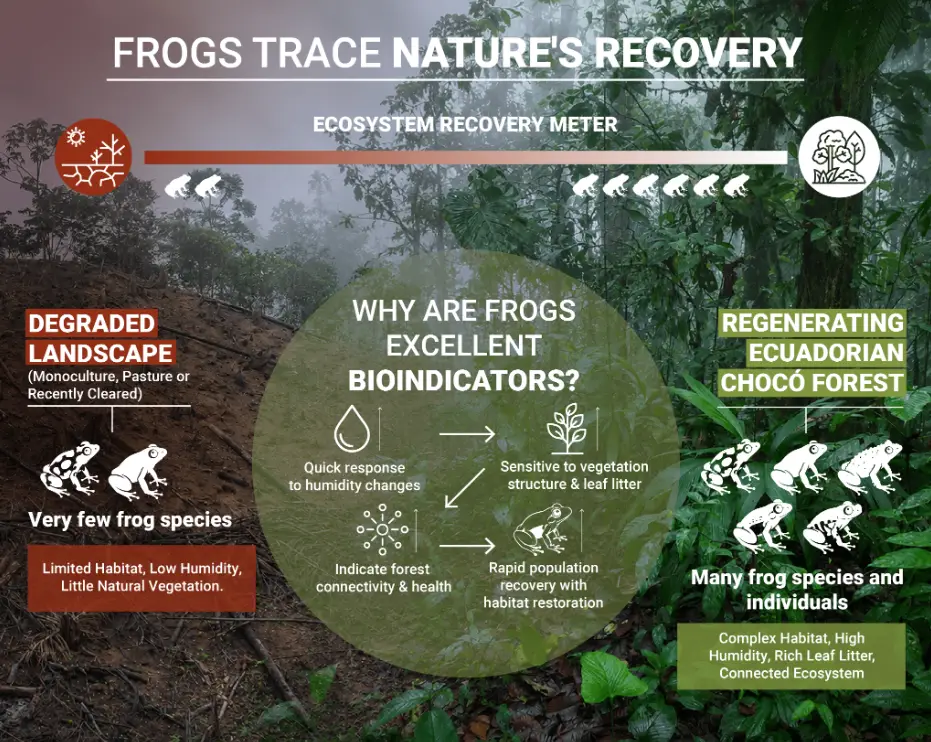
In Ecuador’s Chocó, where more than 60% of the original forest has already been lost, formerly cleared lands and regenerating forests are valuable conservation assets that, when protected alongside mature forests, can play a critical role in restoring biodiversity.
Leonardo de la Cruz, who is from the community around Canandé, is one of the study’s authors. Jocotoco trained Leonardo to perform practical field research, habitat monitoring, and wildlife management. His leadership in the study reflects one of Jocotoco’s core principles: investing in local scientific capacity by training community members to work alongside national and international researchers leads to conservation success.
Your support makes this possible. Together, we protect forests, empower local communities and scientists, and ensure that wildlife has the opportunity to thrive. Give to Jocotoco today.